How to Use Vanadium Redox Flow Battery for Renewable Energy Storage?
The integration of renewable energy sources has become increasingly important. As countries transition to greener energy, energy storage solutions are crucial. Vanadium Redox Flow Battery (VRFB) technology emerges as a viable option.
According to a report by Market Research Future, the global VRFB market is expected to grow significantly, reaching USD 1.2 billion by 2026. This growth emphasizes the need for renewable energy storage systems that can effectively manage fluctuations in energy supply and demand. VRFBs offer unique advantages, such as scalability and a long operational life, appealing to various applications.
Despite these benefits, challenges remain. High initial costs and limited awareness of VRFB technology hinder widespread adoption. This calls for more research and outreach to educate stakeholders. By addressing these issues, the full potential of Vanadium Redox Flow Battery technology can be realized, paving the way for a more sustainable energy future.

Overview of Vanadium Redox Flow Battery Technology and Mechanism
Vanadium redox flow batteries (VRFBs) represent a promising technology for renewable energy storage. These batteries utilize vanadium ions in different oxidation states. They store energy in two electrolyte solutions, allowing for efficient charge and discharge cycles. The design enables scalability, meaning these systems can grow with energy needs.
The mechanism of VRFBs is based on redox reactions. When charging, electrical energy transforms chemical energy. During discharging, the stored energy converts back to electricity. This process is efficient but has its quirks. Sometimes, the electrolyte can degrade over time, affecting performance. Regular maintenance is crucial.
The choice of vanadium provides advantages in energy density and cycle stability. However, sourcing vanadium can be a challenge. Environmental impacts of mining activities need consideration. Overall, while VRFBs offer a solid solution for renewable energy storage, they are not without issues that require ongoing research and development.
Advantages of Vanadium Redox Flow Batteries for Renewable Energy Storage
Vanadium redox flow batteries (VRFBs) offer unique advantages for renewable energy storage. Their ability to efficiently store large amounts of energy sets them apart from traditional battery technologies. The design allows for flexible scaling, making them suitable for various applications, from small solar installations to large wind farms. VRFBs can discharge energy over extended periods, which is a significant boon for balancing intermittent energy sources.
Another notable benefit is the longevity of vanadium redox flow batteries. Their cyclical stress is low, allowing them to last for many years with minimal degradation. This quality means fewer replacements and less waste, promoting sustainability. Their modular structure permits easy maintenance, but access to specialized knowledge can be a barrier for some users.
Nevertheless, VRFBs are not without challenges. The initial costs can be high, deterring some investment. Additionally, the complexity of systems requires careful design and planning. There is still a learning curve for many stakeholders in the energy sector. Despite these hurdles, the potential of vanadium redox flow batteries remains promising for harnessing renewable energy effectively.
Comparison of VRFBs with Other Energy Storage Technologies
Vanadium Redox Flow Batteries (VRFBs) are gaining attention in renewable energy storage. They offer unique advantages over other technologies. Unlike conventional batteries, VRFBs have a long lifespan. They can cycle thousands of times. Their energy capacity can be easily scaled by adjusting the electrolyte volume. This allows flexible installation based on energy needs.
In comparison to lithium-ion batteries, VRFBs provide enhanced safety. They are less prone to overheating and fires. Moreover, VRFBs do not degrade quickly. This means lower replacement costs over time. On the other hand, conventional batteries may require more maintenance. They often lose capacity after several hundred cycles.
**Tip:** Regular maintenance is key. Check your VRFB system for leaks and electrolyte levels. Ensure optimal performance by cleaning connections regularly.
Pump energy storage systems like pumped hydro are effective, but site-specific. They require significant geographical features. VRFBs, however, can be deployed in various locations. This makes them more accessible for widespread use.
**Tip:** Evaluate your location carefully. Proper site assessment can optimize energy storage efficiency. Consider future growth and energy demands during installation.
In conclusion, VRFBs present a compelling option within the energy storage landscape. They combine durability, safety, and adaptability. However, ongoing research is necessary to explore their full potential. Testing and refining systems is crucial for better performance.
Comparison of Energy Storage Technologies
This chart compares the energy storage capacities of various energy storage technologies, including Vanadium Redox Flow Batteries (VRFBs), lithium-ion batteries, lead-acid batteries, pumped hydro storage, and flywheel energy storage. The data demonstrates the diverse capabilities each technology offers for renewable energy storage solutions.
Optimal Applications for Vanadium Redox Flow Batteries in Grid Scaling
Vanadium redox flow batteries (VRFBs) are becoming a vital solution for renewable energy storage. Their unique characteristics make them suitable for large-scale power systems. Multiple reports highlight that VRFBs can achieve over 75% round-trip efficiency. This makes them a strong contender for grid applications, especially in areas with high solar or wind penetration.
The ability to scale VRFBs is particularly attractive. They can be sized according to specific energy needs without losing performance. For instance, a system with a capacity of 10 MWh could serve a community of 1,000 homes. The technology supports longer discharge cycles compared to lithium-ion batteries. This allows for better integration with the grid, enhancing stability and reliability.
Tips: When considering VRFB installations, assess the local electricity demand patterns. Customizing storage solutions can bring significant benefits. Also, evaluate the system's maintenance requirements, as it impacts long-term costs.
Initial costs can be a barrier. However, the longevity of VRFB systems makes up for it. Many systems can last more than 20 years with minimal degradation. A recent analysis suggested that total cost of ownership for VRFBs might be more favorable in the long run. Reflecting on grid scalability, the investment could significantly bolster renewable energy capabilities, yet requires thorough planning and consideration.
Future Trends and Innovations in Vanadium Redox Flow Battery Systems
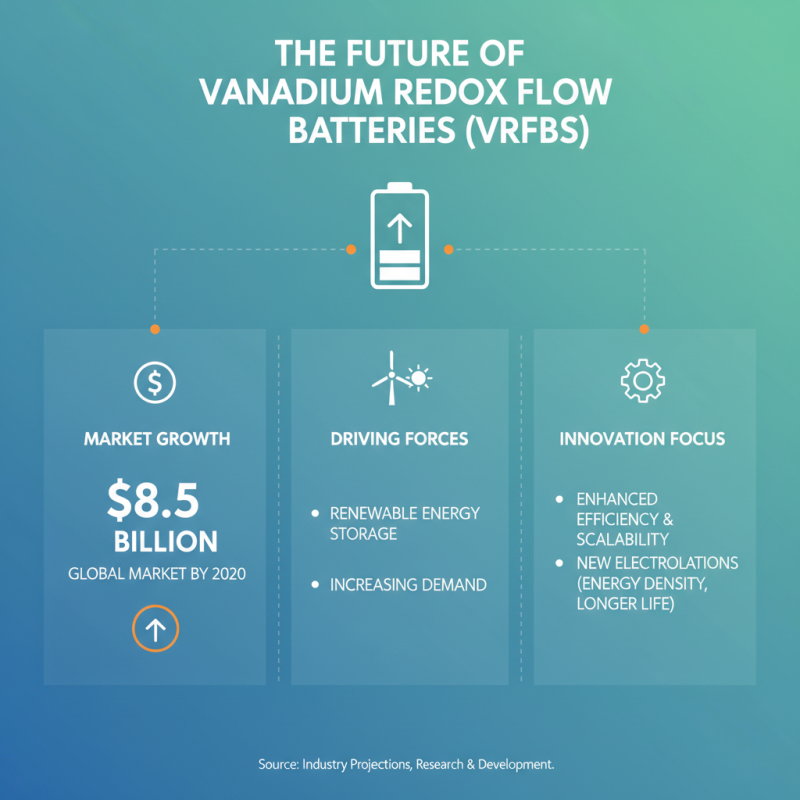
The future of vanadium redox flow batteries (VRFBs) looks promising. Recent projections indicate the global market for VRFBs will reach $8.5 billion by 2030, driven by an increasing demand for renewable energy storage solutions. Innovations in VRFB systems focus on efficiency and scalability. Researchers are exploring new electrolyte formulations that enhance energy density and prolong battery life.
Tips: Regular maintenance is vital. Monitor electrolyte levels frequently. A small imbalance can affect performance.
Efficiency is often questioned. Current efficiencies of VRFBs can reach 75-85%. However, researchers believe there is room for improvement. Innovations in membrane technology are underway, aiming to reduce energy losses. Additionally, blending different vanadium salts is being tested to improve conductivity and charge retention.
Tips: Stay updated on research findings. New studies often offer techniques to enhance battery performance.
Overall, as VRFB technology advances, its role in renewable energy storage will be critical. Stakeholders must remain vigilant about these developments, as they can significantly impact energy management strategies.