How to Choose the Best Low Speed Vehicle Battery?

Choosing the right Low-Speed Vehicle Battery affects range, charging time, safety, and long-term operating costs. A golf cart, neighborhood electric vehicle, or utility buggy may look simple, but each application places different demands on its battery. Weight, terrain, passenger capacity, weather, and daily travel distance all matter. A vehicle climbing wet grass needs more dependable power than one moving across a flat private road.

Battery chemistry is a practical starting point. Lead-acid batteries usually cost less and remain familiar to many technicians. However, they require ventilation, regular maintenance, and careful charging. Lithium batteries often provide lower weight, steadier voltage, and faster charging. Their higher purchase price may be reasonable when the vehicle operates frequently. It should not be assumed automatically. Charger compatibility, battery management systems, installation quality, and warranty coverage deserve equal attention.

Look beyond the advertised capacity. Ask how the battery performs under real loads, not only in laboratory conditions. Check the manufacturer’s cycle rating, usable energy, temperature limits, charging requirements, and service support. A reliable supplier should provide clear specifications and safety instructions. A vague datasheet is a warning sign. So is an unusually low price.

Small details become expensive later. A loose terminal can create heat. An oversized battery can reduce available space or alter handling. A poorly matched charger can shorten service life. Comparing one full operating day, including charging and maintenance, often reveals the better value. There is no perfect choice. The best battery is the one that matches the vehicle, route, climate, and maintenance ability with evidence rather than guesswork.
How to Choose the Best Low Speed Vehicle Battery?

Understanding Low Speed Vehicle Battery Types and Their Applications

How to Choose the Best Low Speed Vehicle Battery?

Choosing a low speed vehicle battery starts with its daily application. Flooded lead-acid batteries suit golf carts, maintenance fleets, and vehicles with regular charging access. They cost less, but require water checks, ventilation, and careful cleaning. AGM batteries reduce maintenance. They work well in enclosed utility vehicles, though repeated deep discharge can shorten their service life.

Lithium-ion batteries, especially lithium iron phosphate, fit shuttle vehicles, delivery carts, and frequent-use neighborhood vehicles. They offer lower weight, steadier voltage, and faster charging. BloombergNEF’s 2023 Battery Price Survey reported an average lithium-ion pack price of 139 dollars per kWh. This decline improves long-term value, but the initial purchase remains higher. The International Energy Agency reported nearly 14 million electric cars sold globally in 2023. That scale is accelerating battery development, although low speed vehicles have different duty cycles. Do not copy passenger-car assumptions.

Tips: Match battery capacity with route length, payload, hills, and daily stops. Check the charger, connector, battery management system, and compartment dimensions together. For lead-acid systems, the U.S. Environmental Protection Agency reports recycling rates above 99 percent for lead-acid batteries. Lithium batteries need proper protection and compatible charging equipment. Cold weather can reduce usable capacity. I have seen operators focus only on amp-hours. That is incomplete. Measure real energy use after a full workday. A smaller battery may work, but only with disciplined charging. Perfect selection is rare. Review the data again.

Matching Battery Capacity to Vehicle Range and Power Requirements

Choosing a low-speed vehicle battery starts with the distance you actually travel, not the largest capacity available. Measure your daily route, including hills, repeated stops, and the return trip. A battery rated at 100 amp-hours does not always deliver 100 usable amp-hours. Reserve matters. Cold weather, aging cells, and heavy loads reduce practical capacity. Multiply system voltage by amp-hours to calculate nominal watt-hours. Then allow a safety margin of about 20 to 30 percent. This margin protects range when conditions become less friendly.

Power requirements deserve equal attention. A vehicle carrying two adults on level pavement needs less current than one climbing a wet slope with tools onboard. Check the motor controller’s peak current and the battery’s continuous discharge rating. A high-capacity battery may still feel weak if it cannot supply short bursts safely. During a field check, watch voltage sag while accelerating uphill. A sharp drop suggests limited power delivery, poor connections, or a tired battery. Small details count. Cable size and terminal condition can change results.

My first range estimate was too optimistic because I ignored stop-and-go driving. That mistake is easy to repeat. Record energy use over several trips, then compare it with payload and terrain. Choose capacity that meets normal travel without deep daily discharges. Oversizing can add weight, cost, and charging time, while undersizing creates inconvenient charging and faster wear. Leave room for gradual capacity loss. Also confirm that the charger matches the battery’s voltage and charging profile.

How to Choose the Best Low Speed Vehicle Battery? - Matching Battery Capacity to Vehicle Range and Power Requirements

Typical planning values for low-speed electric vehicles. Actual range depends on vehicle weight, terrain, speed, temperature, tire pressure, driving style, and battery age.
Low-Speed Vehicle Application Typical System Voltage Typical Motor Power Recommended Battery Capacity Nominal Battery Energy Approx. Usable Energy Estimated Range per Charge Recommended Continuous Discharge Current Recommended Peak Discharge Current Best Battery Selection Considerations
Small utility cart or compact golf cart 36–48 V 2–5 kW 48 V, 100–150 Ah 4.8–7.2 kWh 3.8–5.8 kWh 25–45 km 80–125 A 160–250 A Prioritize sufficient starting current, vibration resistance, and a battery management system with over-current protection.
Passenger golf cart or neighborhood vehicle 48 V 3–7.5 kW 48 V, 150–200 Ah 7.2–9.6 kWh 5.8–7.7 kWh 40–65 km 125–190 A 250–380 A Use a higher-capacity pack when carrying several passengers, operating on slopes, or requiring longer daily travel.
Four-wheel neighborhood electric vehicle 48–72 V 5–12 kW 72 V, 100–160 Ah 7.2–11.5 kWh 5.8–9.2 kWh 45–80 km 100–180 A 220–360 A Match the battery voltage to the motor controller. Confirm that the pack can supply the controller’s maximum current without excessive voltage sag.
Light-duty electric delivery cart 48–72 V 5–15 kW 72 V, 150–220 Ah 10.8–15.8 kWh 8.6–12.6 kWh 55–100 km 150–250 A 300–500 A Choose additional capacity for frequent stop-and-go operation, payloads, ramps, and repeated acceleration.
Heavy-duty utility vehicle or maintenance vehicle 72–96 V 10–25 kW 96 V, 150–250 Ah 14.4–24.0 kWh 11.5–19.2 kWh 70–130 km 200–350 A 400–700 A Prioritize high continuous power, thermal management, robust cabling, and a battery pack rated for the vehicle’s gross weight.
Short-range shuttle vehicle 72–96 V 15–30 kW 96 V, 200–300 Ah 19.2–28.8 kWh 15.4–23.0 kWh 80–150 km 250–420 A 500–850 A Use a pack designed for frequent high-current acceleration and regenerative braking if the vehicle supports it.
Calculation notes: Nominal energy is calculated as voltage × ampere-hours ÷ 1,000. Usable energy assumes approximately 80% of rated energy for lead-acid systems and approximately 90% for lithium iron phosphate systems. Estimated range uses a typical low-speed vehicle energy consumption of about 120–220 Wh/km. Select a battery with at least 15–20% more capacity than the minimum calculated requirement when the vehicle regularly carries heavy loads, climbs hills, operates in cold weather, or must maintain a reserve range.

Comparing Battery Lifespan, Charging Speed, and Maintenance Needs

Choosing a low speed vehicle battery starts with its daily workload, not its advertised chemistry. Lead-acid batteries often deliver about 500–1,000 cycles under suitable conditions. Lithium-ion systems commonly reach 1,000–2,000 cycles, according to battery testing literature reviewed by the U.S. Department of Energy. Temperature, deep discharges, and storage habits can reduce those figures sharply. Real use is messier.

Charging speed changes the vehicle’s usefulness. A small lead-acid pack may need eight to twelve hours after substantial use. Lithium-ion packs often recharge in four to six hours with compatible equipment. The U.S. Department of Energy’s Alternative Fuels Data Center notes that charging time depends on battery capacity, charger output, and remaining charge. Faster is not automatically better. Excess heat can accelerate aging, especially in poorly ventilated enclosures.

Maintenance separates these choices further. Flooded lead-acid batteries require periodic water checks, terminal cleaning, and careful ventilation. Sealed lead-acid designs need less attention, but they still dislike prolonged undercharging. Lithium-ion batteries usually need no water service and include battery-management controls. The International Energy Agency’s Global EV Outlook 2024 reports that many electric vehicle batteries carry warranties near eight years or 160,000 kilometers. That is a useful benchmark, not a promise for every low speed vehicle. I would also question cycle-life claims made without temperature and load conditions. A battery used on short, flat trips may outperform the same battery climbing hills daily. Check charging records, storage temperature, and service access before comparing prices.

Evaluating Battery Safety, Weather Performance, and Operating Conditions

Choosing the best low speed vehicle battery requires more than comparing amp-hour ratings. Safety must fit the vehicle’s real design. Look for documented protection against overcharge, short circuits, overheating, and deep discharge. Batteries tested under UL 2271 or an equivalent national standard deserve closer attention. A secure enclosure, correct fusing, and protected terminals also matter. A large battery is not automatically a safer battery.

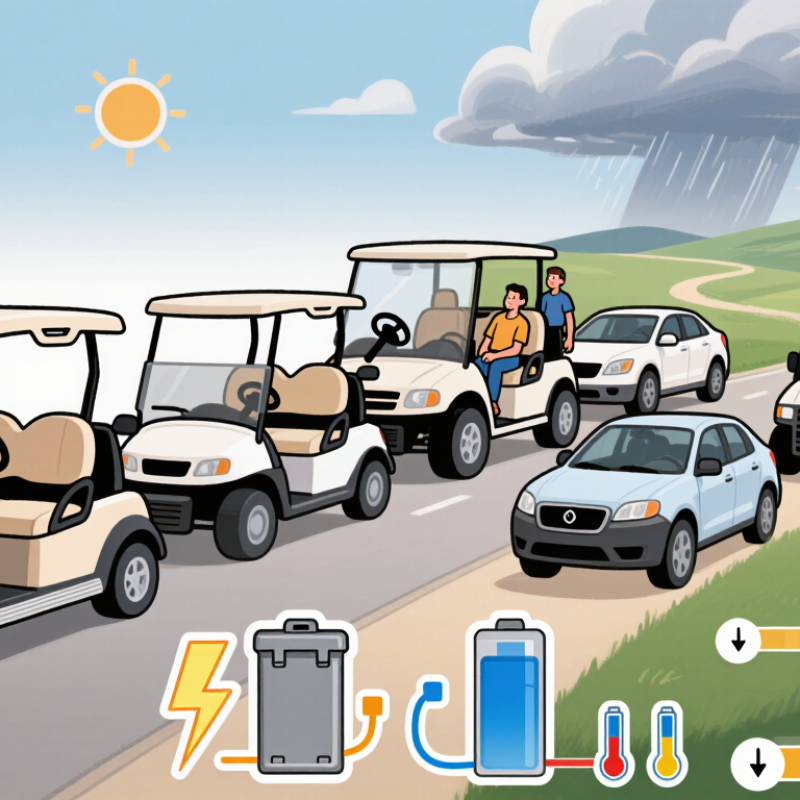
Weather can change daily performance. AAA’s 2019 testing found that electric vehicle range dropped by about 41% at 20°F (-6.7°C). Low speed vehicles may lose less range, but the same cold-weather limits apply. Cold batteries accept charging more slowly. A reliable battery management system should prevent charging when cells are too cold. Heat creates another concern. The International Energy Agency’s Global EV Outlook 2024 highlights thermal management as a key factor in battery durability. Store the vehicle in shade when possible. Ventilation still matters. I would not trust a specification sheet alone.

Tips: Match the battery to hills, passenger weight, stop-and-go traffic, and daily distance. Check the manufacturer’s cold-weather charging limits. Ask for cycle-life test conditions, not only a headline cycle count. Inspect cables after rough-road use. Loose connections create heat. A technician should also verify charger compatibility and resting voltage. These practical checks are easy to skip, and that is where many purchasing mistakes begin.

Choosing the Best Battery Based on Cost, Compatibility, and Warranty

How to Choose the Best Low Speed Vehicle Battery?

Cost should begin with total ownership, not the shelf price. BloombergNEF’s 2023 Battery Price Survey reported an average lithium-ion pack price of 139 US dollars per kWh. However, low speed vehicle batteries also include chargers, cables, installation, and replacement costs. A cheaper lead-acid battery may suit occasional use. A lithium battery can reduce weight and repeated replacement expenses. The calculation is not perfect. Usage patterns change quickly.

Compatibility deserves a physical inspection. Match the vehicle’s voltage, battery dimensions, terminal layout, and required discharge current. Confirm that the charger supports the battery chemistry. Lithium systems may require a compatible battery-management system. A battery that fits the compartment may still damage the charging system. The U.S. Department of Energy reports that low temperatures reduce battery performance, so winter range matters. Test the vehicle under real conditions, including hills, passengers, and stop-start driving.

Warranty language often reveals the battery’s real value. Check coverage length, cycle limits, capacity retention, labor terms, and prorated replacement rules. Do not rely on a large warranty number alone. Battery Council International reports lead-battery recycling rates above 99% in North America, supporting established end-of-life handling. Still, recycling access varies by location. Record installation dates and charging problems. That small habit helps resolve disputes. A balanced choice weighs purchase price, proven compatibility, expected use, and warranty conditions.

How to Choose the Best Low Speed Vehicle Battery?

Compare typical non-brand-specific battery figures to balance upfront cost, expected cycle life, compatibility, and warranty coverage.

Battery Type Typical Upfront Cost Typical Cycle Life Typical Warranty Compatibility Consideration
Flooded Lead-Acid $100–$150 300–700 cycles 1–2 years Requires ventilation and regular water maintenance
AGM Lead-Acid $180–$280 500–900 cycles 2–3 years Sealed design; confirm charger compatibility
Lithium Iron Phosphate $600–$800 2,000–4,000 cycles 3–5 years Requires a compatible charger and battery management system

Values show typical market ranges for commonly used low speed vehicle battery technologies. Actual performance depends on voltage, battery capacity, depth of discharge, charging conditions, temperature, vehicle fitment, and maintenance. Lead-acid batteries generally cost less initially, while lithium iron phosphate batteries can offer a lower long-term cost per cycle when the vehicle and charger are compatible.