
What Are the Best Lithium Marine Batteries from China?
Choosing the best Lithium Marine Batteries from China requires more than comparing prices or advertised capacity. A dependable battery must perform quietly beneath a wet deck, through engine vibration, salt spray, and long hours away from shore power. That real-world pressure exposes weak designs quickly.
China has become a major manufacturing center for lithium battery technology. Its suppliers range from advanced factories with automated testing to small assemblers with limited quality control. The difference matters. A polished website cannot confirm cell consistency, thermal protection, or honest cycle-life data.
Dr. Jeff Dahn, a leading lithium-ion battery researcher, once said, “The battery is the key to the whole thing.” His observation remains useful for marine buyers. The battery affects range, charging time, safety, onboard weight, and maintenance. It is not merely a replacement for lead-acid equipment.
This guide examines Chinese Lithium Marine Batteries through practical criteria. These include LiFePO4 chemistry, battery-management systems, continuous discharge ratings, cold-temperature charging protection, waterproof construction, and service support. We also consider certifications, warranty terms, factory testing, and the traceability of the battery cells.
Some claims deserve caution. “Ten-year life” sounds impressive, but usage conditions can change that result sharply. A battery used daily in hot conditions may age differently from one used occasionally in a cool cabin. Marketing language often hides these details.
The best choice may not be the cheapest model. Nor is the largest capacity always the smartest option. A well-matched battery should fit the vessel, charger, motor, and cruising habits. This review aims to separate measurable performance from attractive promises, while admitting one limitation: supplier data still requires independent verification before purchase.
Lithium Marine Battery Basics: LiFePO4 Cells Deliver 3.2V Nominal Voltage
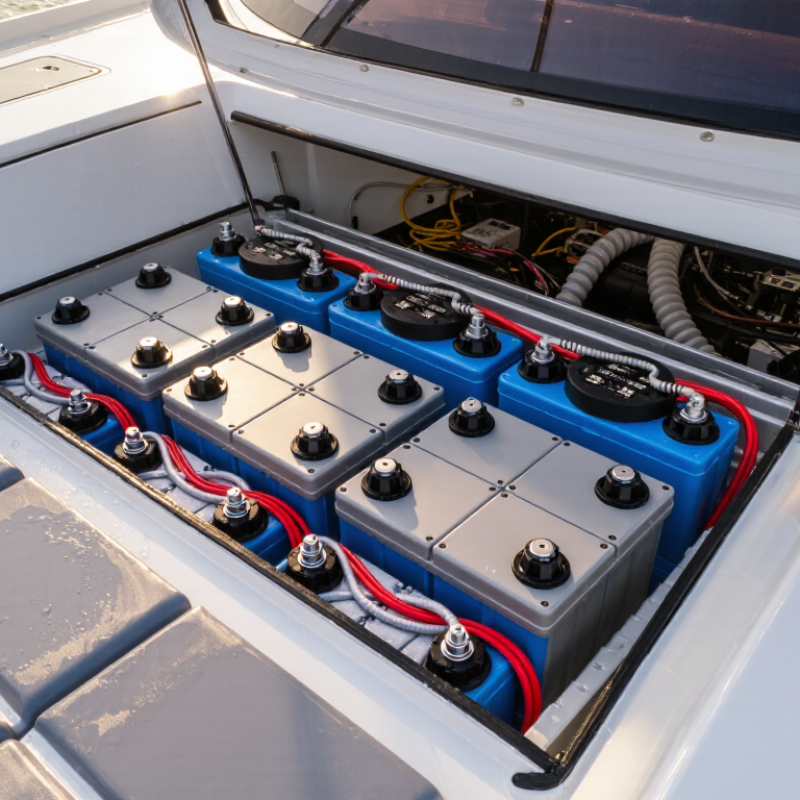
Lithium marine batteries built with LiFePO4 cells offer a 3.2V nominal voltage per cell. Four cells connected in series create a 12.8V battery system. This voltage suits many trolling motors, fish finders, cabin lights, and navigation devices. It also remains relatively stable during discharge, helping equipment operate consistently on the water.
In practical battery evaluations, cell matching matters as much as capacity. A reliable pack should use balanced cells, a protective battery management system, and secure terminals. The BMS should monitor voltage, current, and temperature. Cold charging deserves attention. LiFePO4 cells can suffer damage when charged below freezing without suitable protection. That detail is easy to overlook.
China offers many marine battery suppliers, but construction quality varies. Buyers should request cycle-test data, enclosure ratings, wiring diagrams, and clear warranty terms. Check whether the stated capacity was measured under realistic conditions. A 100Ah label does not guarantee 100Ah in every boat. Cable length, discharge rate, cabin temperature, and aging all change results. I would also inspect the case personally, because a neat product photo proves very little. Small weaknesses can appear around seals, handles, or terminal covers. Research remains necessary.
What Are the Best Lithium Marine Batteries from China? - Lithium Marine Battery Basics: LiFePO4 Cells Deliver 3.2V Nominal Voltage
| Battery Configuration | Nominal Voltage | Typical Maximum Charge Voltage | Common Marine Use | Key Selection Considerations |
|---|---|---|---|---|
| 1 LiFePO4 cell | 3.2 V | 3.65 V | Individual cell testing, educational and engineering applications | Not normally used alone for marine loads; cells require balancing and protective control. |
| 4 cells in series (4S) | 12.8 V | 14.6 V | 12 V lighting, electronics, pumps, refrigerators and trolling systems | A practical replacement for many 12 V lead-acid systems when the charger and equipment are compatible. |
| 8 cells in series (8S) | 25.6 V | 29.2 V | 24 V navigation, communications, auxiliary and propulsion-support systems | Confirm that the charger, inverter, motor controller and protective devices support the battery voltage. |
| 16 cells in series (16S) | 51.2 V | 58.4 V | Higher-voltage electric propulsion and large onboard energy systems | Requires carefully matched high-voltage protection, isolation, cabling and installation procedures. |
Important LiFePO4 Marine Battery Specifications
| Specification | Typical Technical Reference | Why It Matters in a Marine Application |
|---|---|---|
| Cell chemistry | Lithium iron phosphate, LiFePO4 | Offers good thermal stability and long cycle life compared with many other lithium-ion chemistries. |
| Nominal cell voltage | 3.2 V per cell | Determines the series count needed for 12 V, 24 V or 48 V-class systems. |
| Usable energy | Approximate calculation: nominal voltage × ampere-hours × permitted depth of discharge | A 12.8 V, 100 Ah battery has about 1.28 kWh of nominal stored energy before application-specific limits. |
| Recommended operating temperature | Discharge is commonly permitted below 0°C; charging below 0°C generally requires protection or heating | Cold-weather charging can damage cells, so low-temperature charge cut-off is important for boats used in cold climates. |
| Battery-management system | Required for overcharge, over-discharge, over-current and temperature protection | The BMS helps protect the cells but does not replace correct fusing, charging and wiring practices. |
| Ingress protection | Select an enclosure rating suitable for the installation location; IP65 or higher is often considered for splash-prone areas | An enclosure rating alone does not guarantee suitability for immersion, saltwater exposure or condensation. |
| Charging profile | Use a LiFePO4-compatible charger matched to the battery voltage and BMS limits | Lead-acid equalization settings and incompatible charging voltages may damage the battery or trigger protection. |
| Safety installation | Use correctly sized cables, fuses or circuit breakers, secure mounting and accessible isolation | Marine vibration, moisture and high fault current make mechanical protection and over-current protection essential. |
Related Posts
-
How to Choose the Best Lithium Marine Batteries for Your Boat?
-
Top 10 Lithium Marine Batteries for Boats to Buy?
-
How to Use a Latching Relay for Efficient Circuit Control
-

How to Choose the Right Energy Storage Battery for Your Needs?
-

What is Power Energy Battery and How Does It Work?
-

Why Are Lithium Batteries So Important for Our Future Energy Needs